




Supplier Onboarding Is Only as Fast as the People Who Approve It
Supplier Onboarding Is Only as Fast as the People Who Approve It
Supplier onboarding is often treated as a master data problem.
A new supplier needs to be created in the ERP system. The right tax information must be captured. Bank details need to be checked. Payment terms must be agreed. Procurement policies must be followed. The supplier may need to pass compliance, risk or sustainability checks before the relationship can begin.
But supplier onboarding is not just a data-entry exercise.
It is a cross-functional business process involving decisions from people across the organisation. Procurement, finance, accounts payable, master data teams, risk specialists, tax teams and business stakeholders may all need to contribute. In many cases, several of those people are not regular SAP users.
That is why supplier onboarding can take far longer than expected.
The system may be working correctly. The workflow may be configured. The forms may be complete. But the process is still only as fast as the people who need to review, confirm and approve the request.
Supplier onboarding affects more than procurement
A delayed supplier onboarding request can have an immediate operational impact.
A project team may be waiting to place an order. A department may need a specialist service urgently. A production site may be trying to avoid a disruption. A new supplier may be required because an existing one cannot fulfil demand. A finance team may be unable to process an invoice because the supplier record is incomplete.
The business user who requested the supplier may see onboarding as a simple administrative step. But the organisation needs to make sure that the supplier is legitimate, the data is accurate and the correct controls have been applied.
That balance matters.
If the process is too loose, the organisation creates risk. Duplicate suppliers may be created. Incorrect bank details may be entered. Tax information may be missing. Payment terms may be inconsistent. Spend may be committed without proper approval. Fraud risk can increase.
But if the process is too difficult, users may look for workarounds. Orders may be raised against the wrong supplier. Invoices may be delayed. Procurement teams may face pressure to bypass controls. Master data teams may spend their time chasing missing information rather than improving data quality.
The goal is not simply to add more workflow steps. It is to make the controlled process easier to complete.
Why supplier onboarding requests get stuck
Most supplier onboarding processes include several stages.
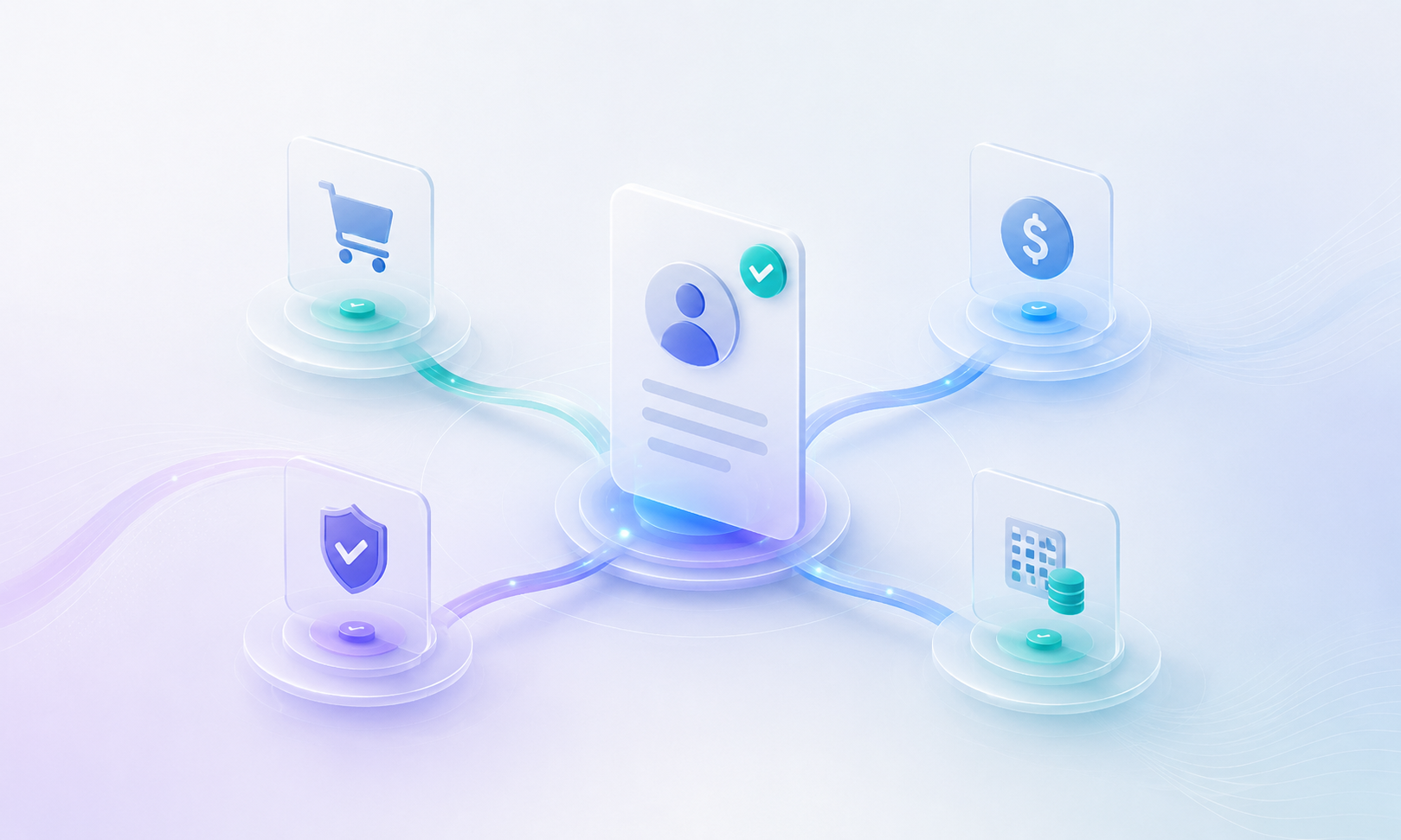
A business user submits a request. Procurement reviews whether the supplier is appropriate. Finance may check payment terms and banking details. Tax or compliance teams may validate legal information. A data governance team may review the supplier record before it is created or replicated into the relevant systems.
The exact process varies from one organisation to another, but the underlying challenge is common: the request has to move between different people with different responsibilities.
Some of those people work in SAP or SAP Master Data Governance every day. Many do not.
A procurement manager may only need to approve the commercial justification. A budget holder may need to confirm that the supplier is required. A risk owner may need to review one specific warning. A finance approver may need to check payment terms or supporting documentation.
For these users, the supplier request is one task among many. If it arrives as an email notification, it may be overlooked. If it requires a separate login, unfamiliar navigation and a detailed review screen, it may be postponed. If the request lacks context, the approver may have to ask follow-up questions before making a decision.
The result is a process that is technically automated but operationally slow.
The weakest point is often outside the master data team
Master data teams are frequently measured on data quality, turnaround time and governance.
But they do not control every part of the process.
They may receive a complete supplier request and process it quickly, only to find that the request is waiting for a business owner to confirm the justification. They may need procurement to validate the supplier category. They may need finance to review proposed payment terms. They may be waiting for a manager to approve a risk exception.
This creates a familiar pattern.
The master data team checks the workflow. The request is still waiting. Someone sends a reminder. The approver cannot find the original email. Another message is sent. A meeting or Teams chat follows. Eventually, the decision is made, but the data team has lost time chasing an action that should have been straightforward.
This is not a problem that can be solved by adding another dashboard.
The better solution is to bring the decision to the approver in the place where they already work.
Better approvals need better context
A supplier onboarding approval should not be reduced to a simple “approve” or “reject” button.
Approvers need enough information to make a good decision.
That may include:
- the supplier name and country
- the requesting department
- the reason the supplier is needed
- the supplier category
- the expected spend
- proposed payment terms
- bank account details
- supporting documents
- validation warnings
- risk indicators
- any fields that have changed during the review process
The right information will depend on the role of the approver.
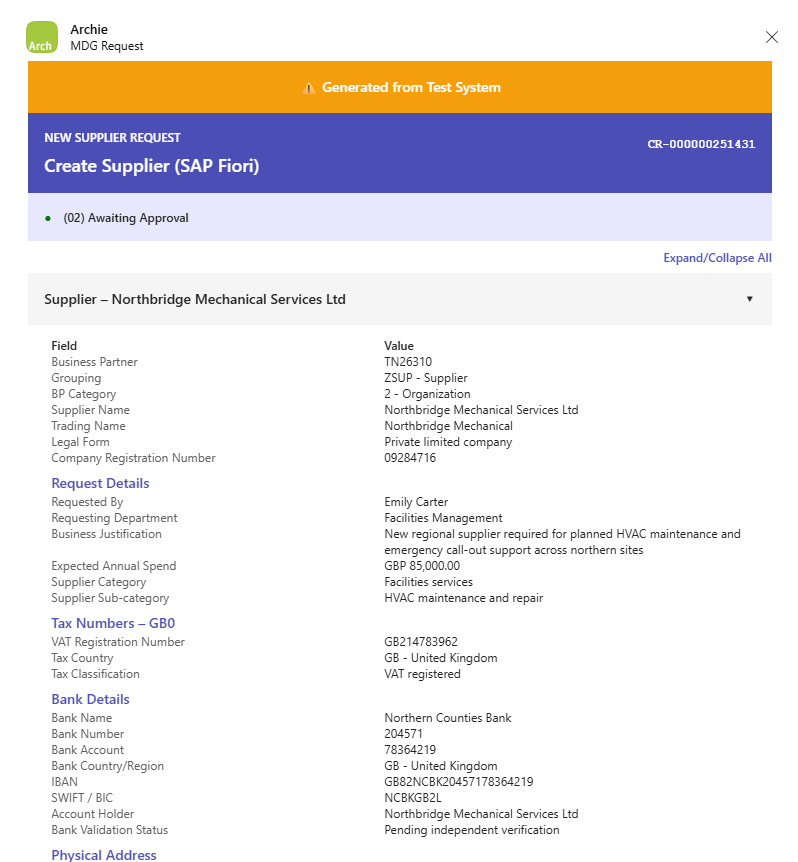
A procurement approver may need to understand the commercial justification and supplier category. A finance approver may care about payment terms, bank details and tax information. A risk owner may need to see the validation warning and supporting evidence.
The best approval experience presents the information that matters to that person, without forcing them to navigate through every field in the supplier record.
That is where Microsoft Teams can play an important role.
Bringing supplier onboarding approvals into Microsoft Teams
Looply enables SAP business processes to be extended into Microsoft Teams.
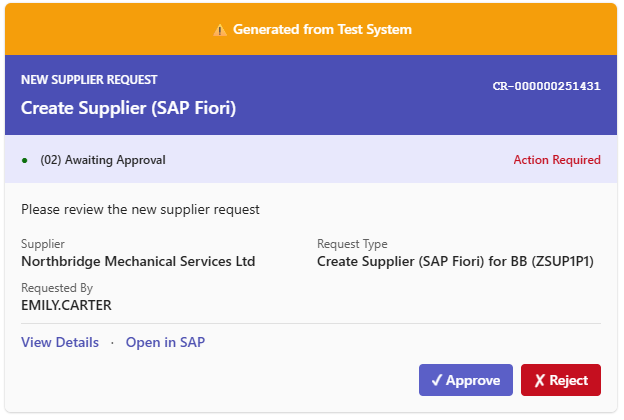
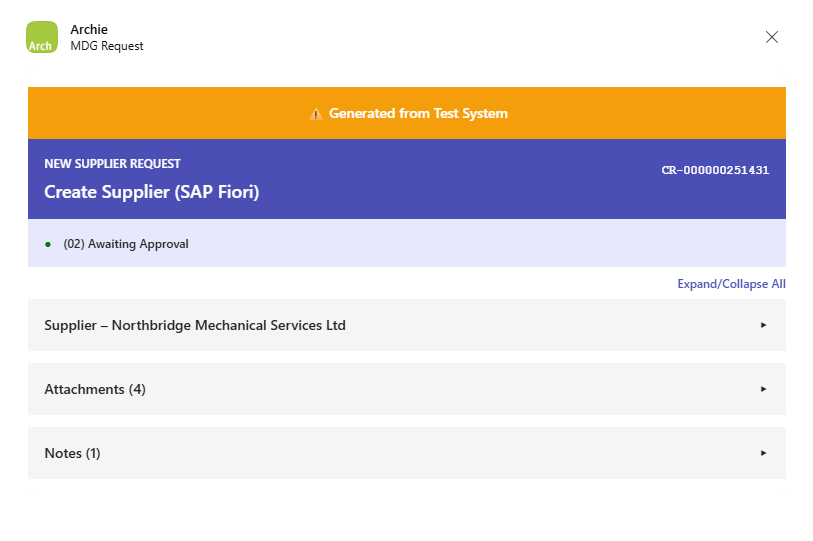
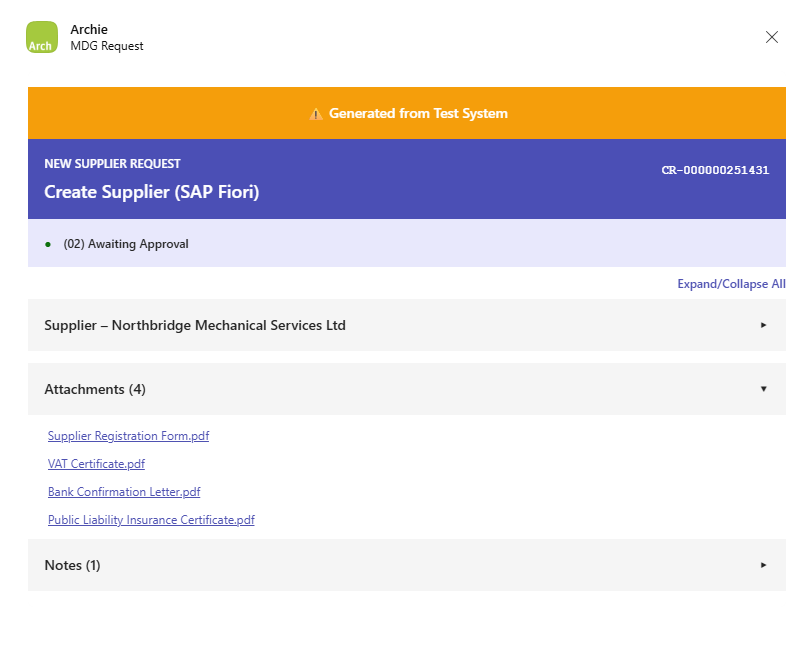
When a supplier onboarding request reaches an approval step, Looply can send the relevant task to the right person in Teams. The approver receives an Adaptive Card containing the information they need to review the request and take action.
The request can be tailored to the approver’s role.
A business manager may receive a concise approval request showing the supplier name, business justification and expected spend. A procurement approver may see the supplier category and sourcing context. A finance approver may see payment terms and supporting documentation. A risk or compliance approver may receive the relevant warning and evidence.
The user can then approve, reject or comment directly from Teams.
This reduces friction because the approver does not need to monitor another inbox, remember a separate login or navigate an unfamiliar application. The task appears in the same environment they use for communication, meetings and daily collaboration.
SAP remains the system of record. Teams becomes the place where the business user interacts with the task.
Supplier onboarding and SAP Master Data Governance
For organisations using SAP Master Data Governance, supplier onboarding is often managed through a structured change request process.
That provides important control. The organisation can define which information must be captured, which validations need to run, which approvals are required and when the supplier record can be activated or replicated.
But the effectiveness of the process still depends on user participation.
A well-designed MDG workflow can route the request to the correct approver. It cannot guarantee that the approver will log in promptly, understand the request immediately or prioritise the task over everything else competing for attention.
Looply helps bridge that gap.
By extending the relevant MDG approval step into Teams, organisations can preserve the underlying governance process while making it easier for business users to participate.
This is particularly useful for approvers who only touch SAP MDG occasionally. They do not need to become expert users of the MDG interface. They need a clear request, the right context and a simple way to respond.
Beyond approval: collecting missing information
Supplier onboarding does not always follow a perfectly linear path.
Sometimes information is missing. A document may need to be uploaded. A business owner may need to confirm a cost centre. A procurement specialist may need to clarify the supplier category. A finance team may need updated bank details or tax information.
These are not always approval tasks. Sometimes they are enrichment tasks.
The same principle applies.
Instead of relying on email threads or spreadsheet updates, the organisation can bring the request for information into Teams. The user can be asked to provide the missing detail, confirm a value or submit supporting information as part of the controlled process.
This is important because supplier onboarding delays are often caused by small information gaps rather than complex decisions.
Making those tasks easier to complete can have a significant impact on the overall process.
Reducing risk without slowing the business down
Supplier onboarding controls exist for good reasons.
Supplier records affect purchasing, payment processing, financial reporting and regulatory compliance. Poor-quality supplier data can create duplicate payments, reporting errors, audit issues and fraud exposure.
But control and speed do not have to be opposites.
A slow process is not necessarily a well-controlled process. In fact, when users become frustrated and start looking for workarounds, excessive friction can weaken governance.
A better process makes the compliant route the easiest route.
That means presenting users with the task at the right time, in a familiar environment, with enough context to make a good decision. It means capturing the decision in a structured way and returning it to the underlying SAP process. It means reducing informal approvals, disconnected email trails and manual chasing.
The result is a process that is both easier to use and easier to govern.
A better experience for procurement, finance and the business
Improving supplier onboarding creates benefits across the organisation.
For procurement teams, it means fewer delays when engaging new suppliers and less time spent chasing approvals.
For master data teams, it means better-quality requests, fewer manual follow-ups and more efficient governance.
For finance and AP teams, it means cleaner supplier records, fewer payment issues and a reduced risk of incorrect banking or tax information.
For business users, it means a simpler process. They receive a clear task in Teams, review the relevant information and take action without needing to understand the full complexity of the underlying SAP process.
And for suppliers, it means a smoother start to the relationship.
Supplier onboarding as part of a wider process strategy
Supplier onboarding is a good example of a broader challenge facing SAP organisations.
Many business processes are technically automated but still depend on people responding promptly. The weak point is often not the system transaction itself. It is the human decision or data input required to move the process forward.
That same pattern appears in purchase requisition approvals, supplier invoice exceptions, master data changes, finance approvals, policy acknowledgements and HR processes.
The opportunity is to improve those decision points.
By bringing SAP tasks into Teams, organisations can make it easier for users to participate in structured business processes without asking them to spend more time navigating specialist systems.
Conclusion
Supplier onboarding is not just about creating a supplier record.
It is a cross-functional business process that depends on people across procurement, finance, master data, compliance and the wider business. If those people cannot see the task, understand the request or respond easily, the process slows down.
The answer is not to remove controls. It is to make the controlled process easier to complete.
Looply enables organisations to extend supplier onboarding approvals and enrichment tasks into Microsoft Teams, so that users can respond where they are already working. SAP remains the system of record. The governance process remains intact. But the user experience becomes simpler, clearer and faster.
Because supplier onboarding is only as fast as the people who approve it.