




AI-Ready Master Data Starts with Better Business Participation
AI-Ready Master Data Starts with Better Business Participation
Artificial intelligence has moved rapidly up the business agenda.
Organisations are exploring how AI can improve customer service, accelerate decision-making, automate routine work and uncover insights from growing volumes of business data. Yet there is a fundamental issue that can easily be overlooked amid the enthusiasm for new technology.
AI is only as reliable as the data on which it depends.
If the underlying data is incomplete, inconsistent or out of date, AI will not solve the problem. It may simply process poor-quality data faster and at a much greater scale.
This is one reason why data quality and data governance have become increasingly important parts of the AI conversation. Gartner has warned that many organisations do not yet have the right data-management practices for AI and has predicted that a significant proportion of AI projects unsupported by AI-ready data will be abandoned.
The challenge is not only technical. Organisations also need to improve the business processes through which data is created, reviewed, corrected and maintained.
AI ambitions depend on trusted data
The term “AI-ready data” covers a wide range of requirements. Depending on the use case, organisations may need to consider data quality, completeness, context, lineage, metadata, privacy, security and governance. Different AI models will require different combinations of structured and unstructured data.
Master data is only one part of that wider picture, but it is an important part.
Master data describes the core entities on which business processes depend: customers, suppliers, materials, products, employees, cost centres, profit centres, general-ledger accounts and other organisational structures.
When these records are inaccurate, the consequences already appear throughout day-to-day operations. A supplier may be set up with incomplete payment information. A material may be classified incorrectly. A customer record may contain duplicate or outdated details. A cost centre may be assigned to the wrong hierarchy. An employee record may no longer reflect the person’s current role or organisational position.
Poor-quality data creates inefficiency even before AI enters the picture. It leads to manual corrections, delayed transactions, reporting inconsistencies and additional work for operational teams.
As organisations make greater use of AI, the importance of trusted master data increases. AI tools need dependable information if they are going to support business users with useful recommendations, identify meaningful patterns or help automate decisions.
Master data governance depends on business users
It is tempting to treat master data governance as the responsibility of a central data-management team.
In practice, the central team rarely has all the information needed to make every decision.
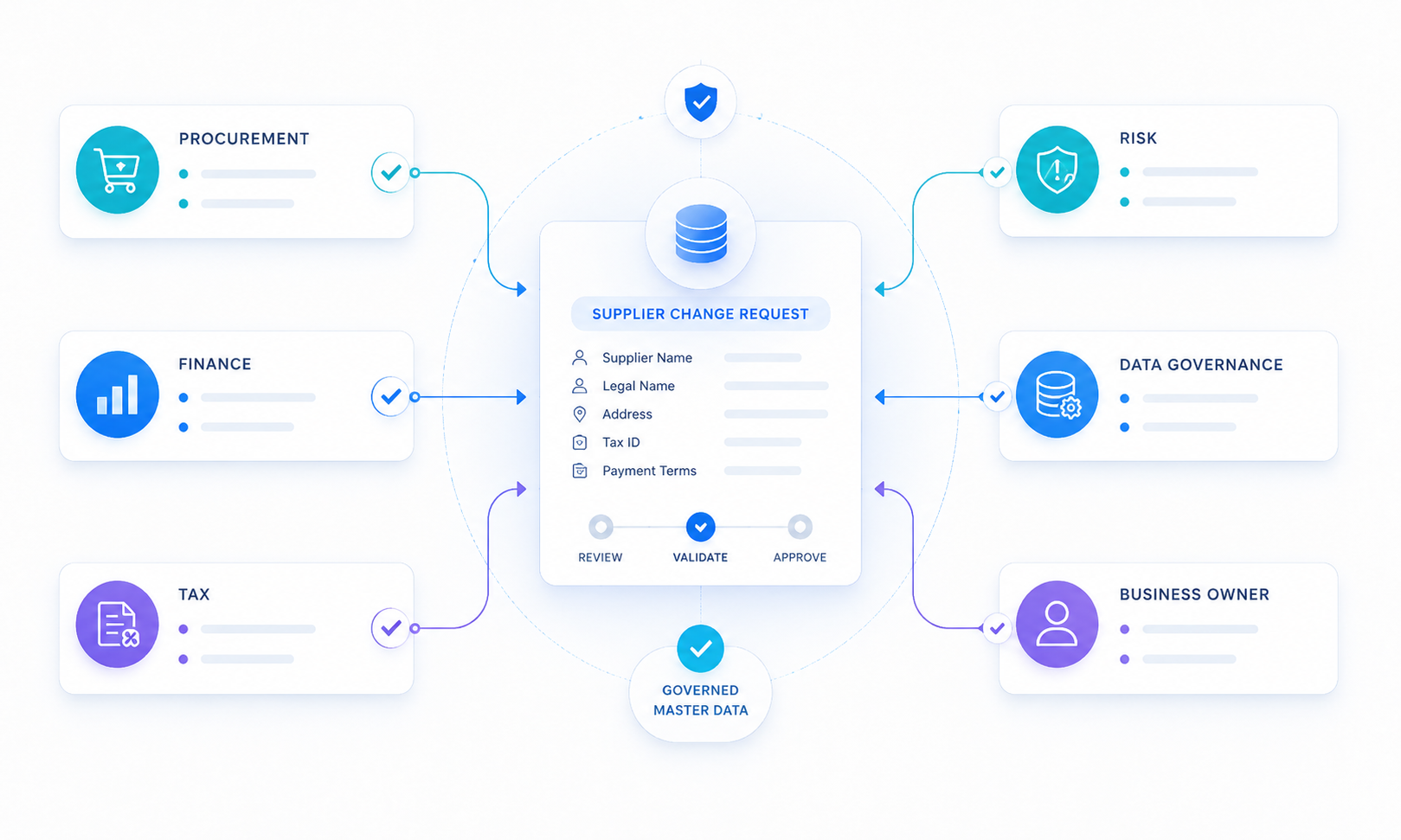
A request to create or change a supplier may need input from procurement, finance, tax, risk and the business owner. A customer request may need confirmation from sales, credit control or compliance teams. A material-master change may require the knowledge of product specialists, operations teams or local business units. A new cost centre may need review by finance and controlling.
The central data team can define governance rules, coordinate the process and maintain oversight. However, many decisions still rely on people across the business.
These people are often not regular users of the master data system. They may only need to review a request occasionally. They may have competing priorities and limited time. They may receive a notification by email but postpone logging into a specialist application until later.
This creates a familiar bottleneck: the technology is capable of managing the process, but the process still depends on people responding.
Why master data requests slow down
Master data requests do not usually become delayed because someone has made a deliberate decision to block progress.
More often, the delay is caused by friction.
A request may be routed to an approver who does not regularly access SAP. The notification may arrive in an already crowded email inbox. The approver may not immediately understand what has changed or why their input is required. They may need to open a separate application, authenticate again and navigate through several screens before reaching the relevant information.
If the approver has a question, the process may move outside the system into an email exchange or a separate chat message. If additional information is required, someone may create a spreadsheet to collect responses. If the request becomes urgent, the data team may spend time chasing individuals manually.
None of these activities is unusual. Taken together, however, they slow down the process and make it harder to maintain a clear audit trail.
The result is not simply an administrative inconvenience. Delayed master data decisions can hold back wider business activity.
A supplier cannot be used efficiently until the relevant record is complete and approved. A product launch may be affected if material data is missing. Reporting may be delayed if financial master data is incomplete. A downstream transaction may fail or require correction if a record is inaccurate.
The quality of master data depends partly on the quality of the approval process around it.
What business approvers need to see
Improving the process does not mean presenting business users with every field in a complex master data record.
The goal should be to show the information that supports a clear and informed decision.
For a master data approval, this may include:
- the type of request;
- the person who submitted it;
- the business reason for the change;
- the fields that have been added or amended;
- the previous and proposed values;
- relevant validation warnings;
- potential duplicate records;
- supporting documentation;
- comments from earlier participants in the process; and
- a clear explanation of the action required.
The precise content will vary by process.
A supplier request may need to highlight payment details, tax information and risk indicators. A customer change may need to draw attention to credit or compliance information. A cost-centre request may need to show the proposed hierarchy and responsible manager. A material-master request may need to focus on classification, plant data or procurement information.
The important point is that the approver should not need to search through a large record to work out what matters.
A well-designed approval task should bring the relevant context to the surface.
Bringing master data actions into Microsoft Teams
This is where Microsoft Teams can play a useful role.
For many organisations, Teams has become one of the places where employees already spend a significant part of their working day. It is used for meetings, messages, collaboration and day-to-day communication.
Rather than expecting occasional approvers to monitor another inbox or regularly log into a specialist system, organisations can bring selected master data tasks into Teams.
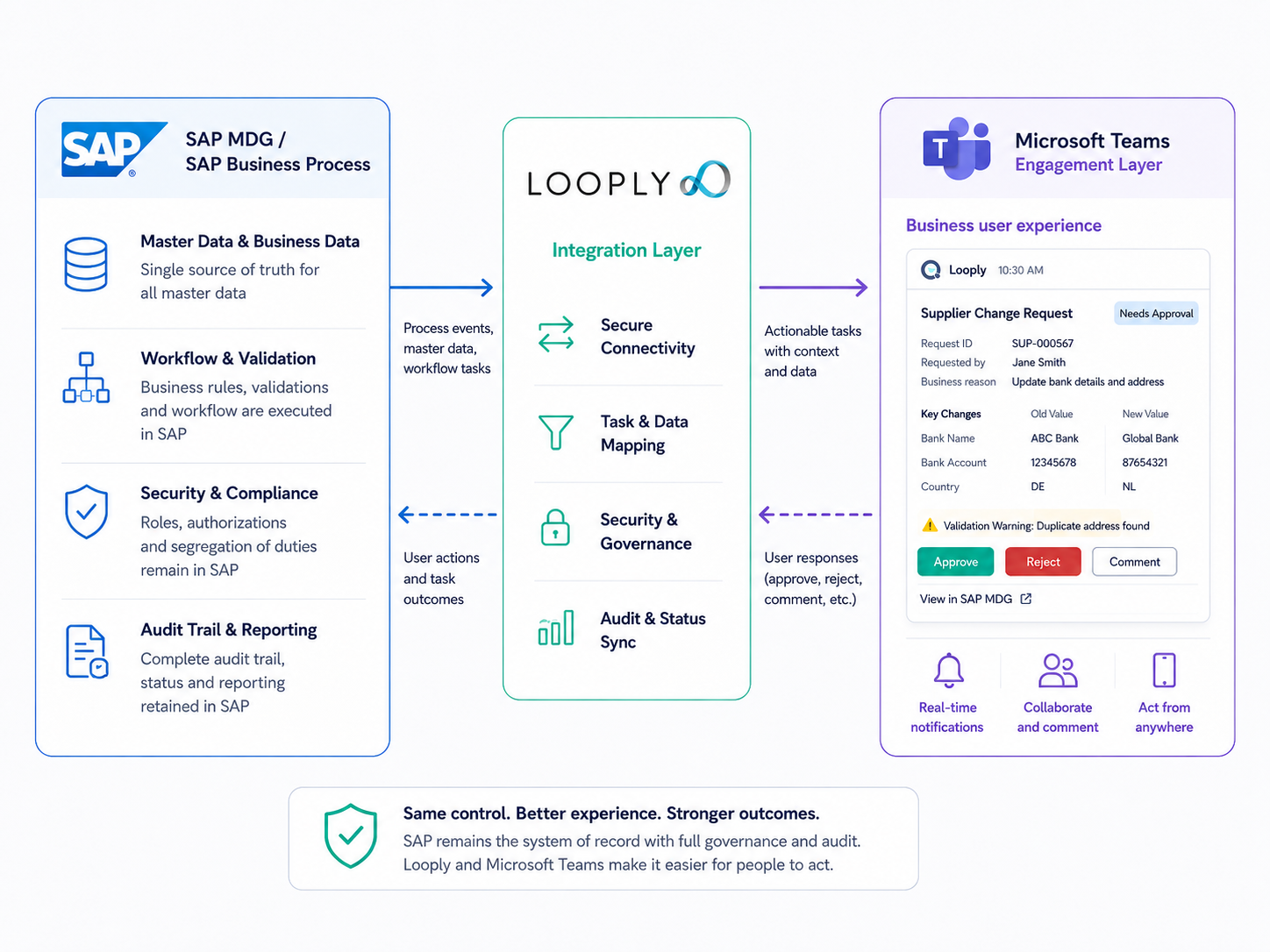
Using Looply, an SAP master data process can trigger an actionable Teams card for the relevant business user. The card can present the essential information clearly and allow the recipient to respond without leaving the flow of their normal work.
Depending on the process, the user may be able to approve, reject or comment directly from Teams. Where a request is more complex, the card can include a link to the appropriate SAP, SAP MDG or SimpleMDG screen so that the user can investigate further or complete a more detailed enrichment step.
This is not about reproducing every function of a specialist master data application inside Teams.
It is about reducing unnecessary friction at the points where business participation is needed.
Keeping SAP as the system of record
Bringing a task into Teams does not mean moving the underlying process out of SAP.
SAP MDG and other SAP business processes can continue to manage the workflow, apply validation rules, record the status of the request and maintain the appropriate audit trail. Teams becomes an engagement layer: a more convenient place for the user to receive the task, review the relevant context and submit an action.
This distinction is important.
Informal workarounds can appear convenient in the short term, but spreadsheet-based approvals and fragmented email exchanges weaken control. They create additional versions of information, make it harder to understand the current status and increase the risk that decisions are not captured consistently.
A controlled Teams integration provides a better balance.
The business user gets a simpler experience. The data team retains visibility. The organisation continues to use SAP as the authoritative source of data and process status.
Better participation improves data quality
Technology remains essential to master data governance.
Organisations need appropriate data models, validation rules, duplicate checks, workflow controls and integration across their system landscape. They also need clear ownership and effective governance policies.
But even a well-designed process can lose momentum if the people who need to participate do not respond.
Making business tasks easier to complete can improve both speed and quality. Approvers are more likely to act promptly when the request reaches them in a familiar channel. They are more likely to make an informed decision when the relevant information is presented clearly. Data teams spend less time chasing responses and more time focusing on the quality of the data itself.
The same principle applies across many master data processes, including:
- supplier onboarding and supplier changes;
- customer and business-partner maintenance;
- material-master creation and enrichment;
- financial master data;
- organisational structures;
- employee-data validation; and
- data-quality remediation exercises.
Each use case is different, but the underlying challenge is similar: the process depends on the right person taking the right action at the right time.
A practical step towards AI readiness
No single workflow improvement will make an organisation AI-ready.
Trusted data depends on a wider combination of technology, governance, accountability and continuous improvement. AI readiness also needs to be assessed in the context of specific use cases.
However, organisations do not need to wait for a large AI programme before improving the foundations.
Master data processes are a practical place to start.
If requests remain stuck in inboxes, if approvers struggle to understand what has changed, or if data teams repeatedly chase business users for a response, there is an opportunity to make the process more effective.
By bringing selected master data tasks into Microsoft Teams, organisations can make it easier for business users to participate while keeping SAP at the centre of the process.
Better participation leads to better-governed master data.
And trusted master data gives organisations a stronger foundation for the next generation of AI-enabled business processes.