



Looply Packaged Service for SAP MDG
Bring SAP MDG workflow actions into Microsoft Teams
Make it easier for business users to participate in SAP Master Data Governance — without replacing your MDG workflows or rebuilding them in another platform.
The Looply Packaged Service for SAP MDG provides a reusable, configuration-driven framework for extending MDG Change Request workflow steps into Microsoft Teams.
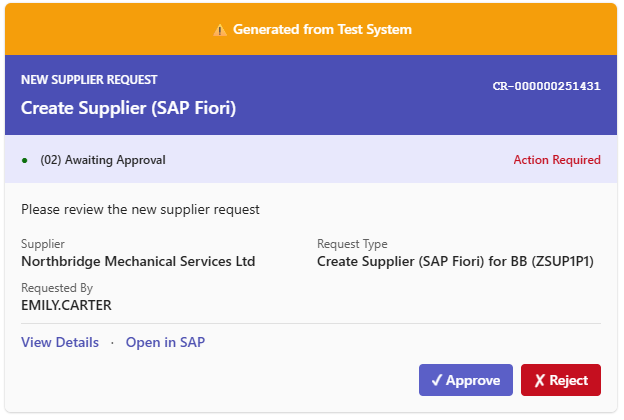
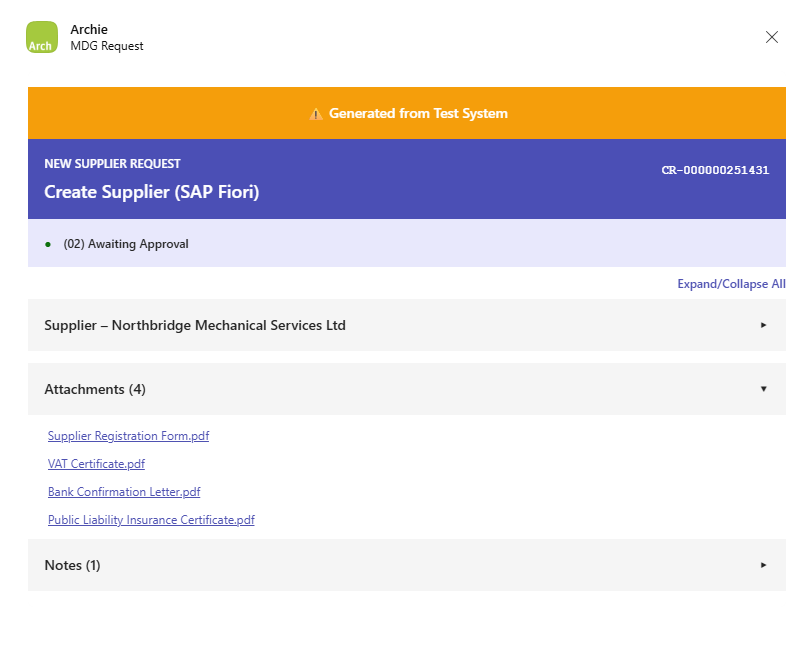
Change Request data is dynamically transformed into clear, actionable Teams cards. Users can review the information relevant to their step and, where appropriate, approve or reject directly from Teams. Where the process requires further data entry or specialist processing, the card takes the user directly to the relevant SAP Fiori or NetWeaver Business Client application.
SAP MDG continues to control the process. Looply makes it easier to participate in it.
Keep SAP MDG at the centre of governance
Looply does not create a parallel approval process.
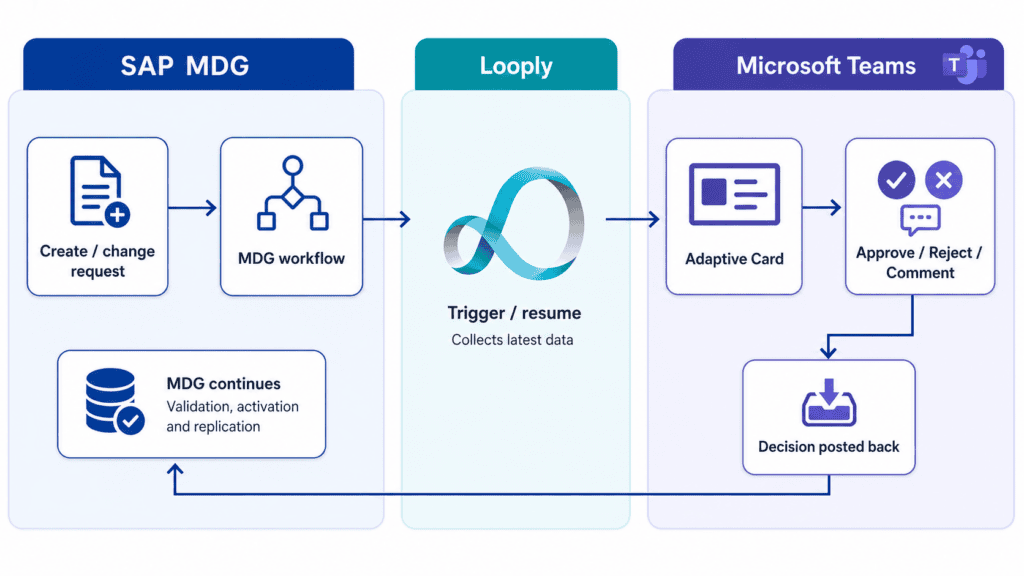
Your existing SAP MDG configuration continues to control the Change Request, workflow routing, approval steps, business rules, validation, activation and subsequent processing.
Looply responds to the relevant MDG workflow step, retrieves the Change Request context and presents it to the assigned user in Microsoft Teams.
When an action is completed through Teams, that decision is passed back into the existing MDG process so that the workflow can continue normally.
This means you can improve the experience for approvers and business users without redesigning the governance model that already exists in SAP.
One packaged framework. Across your MDG landscape.
SAP MDG can govern many different kinds of master data, and individual organisations frequently have large numbers of Change Request types.
Building and maintaining a separate Teams integration for each one would simply create another layer of custom development.
The Looply Packaged Service takes a different approach.
Card content is generated dynamically from the underlying MDG Change Request and business model. The framework can therefore be used across MDG scenarios such as:
Supplier and Business Partner
Supplier creation, supplier changes, bank data, purchasing data, tax information and other governed business partner changes.
Customer
Customer creation and extensions, sales-area changes, credit-related information and other customer master updates.
Material
Material creation, plant extensions and cross-functional material master governance.
Financial Master Data
Cost centres, profit centres, G/L accounts and other governed financial objects.
The same underlying framework is reused rather than developing a new integration for every master-data object or Change Request type.
Automatically turn complex MDG data into usable Teams cards
A raw MDG Change Request can contain a large amount of technical and business information.
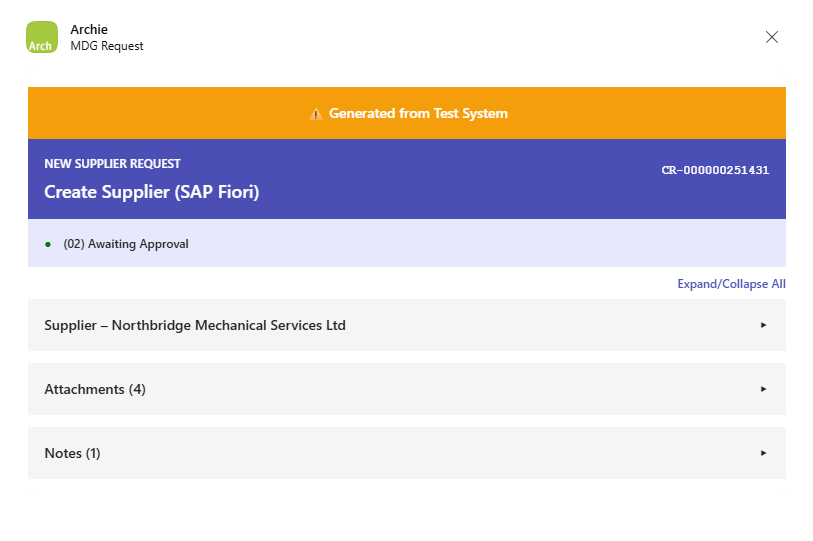
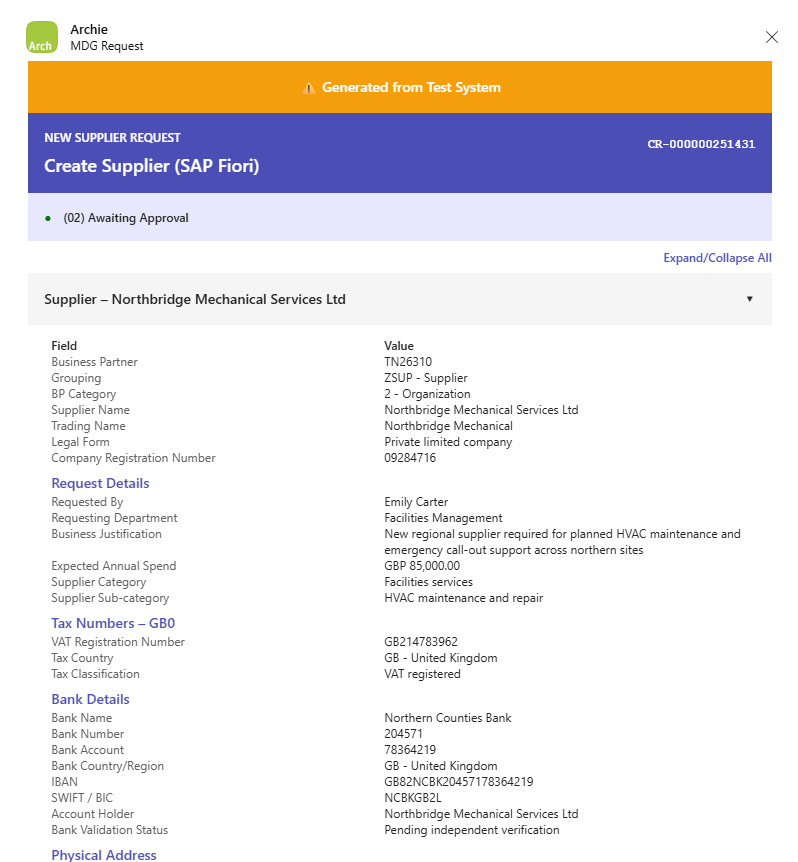
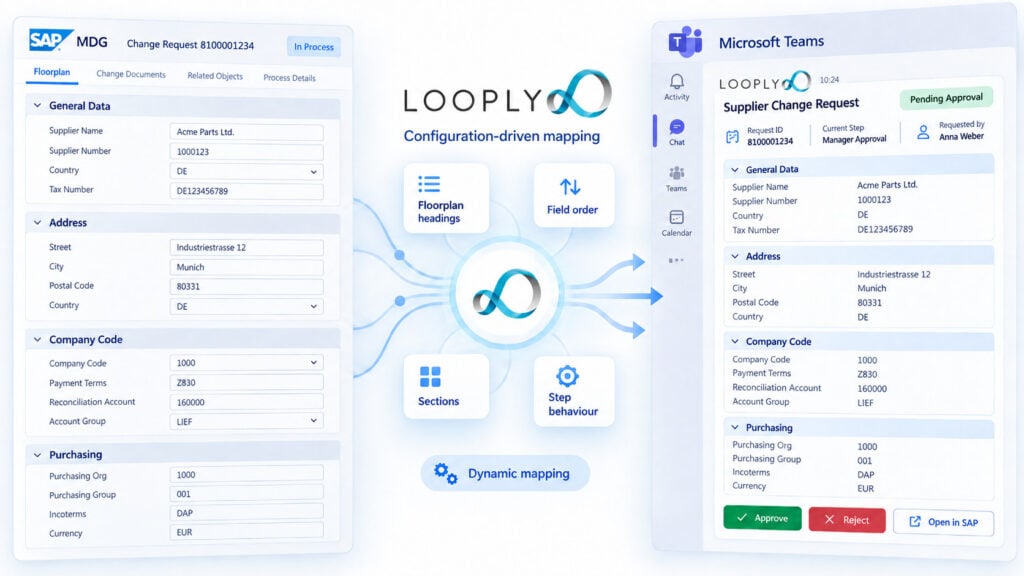
Looply automatically reads the Change Request structure and uses the headings defined within the SAP floorplan to organise the data into logical groups on the Teams card.
The result is a card that reflects the structure of the underlying MDG process without having to manually define every field.
Additional configuration allows you to refine that presentation further.
You can:
- control which information is presented to the user;
- change the order in which fields appear;
- organise fields into configurable sections;
- tailor presentation for particular MDG scenarios; and
- apply model-specific enhancement logic where additional business interpretation is required.
This combines the scalability of dynamically generated cards with the flexibility needed to create a useful business experience.
You are not designing every card from scratch. You are configuring how a reusable MDG framework should present the information.
The right action in the right place
Not every MDG workflow step should work in the same way.
Some steps simply require a decision. Others require the user to inspect, correct or enrich the master data before the workflow can continue.
Looply supports both.
Approve directly in Microsoft Teams
Where the user already has enough information to make the decision, the Teams card can provide actions such as Approve and Reject, together with comments or other information required by the process.
The user can complete the action immediately without opening SAP.
Continue processing in SAP
Where a step requires data enrichment or detailed interaction with the Change Request, the Teams card acts as the user’s notification and starting point.
The user can review the key context in Teams and then open the appropriate SAP Fiori application or NetWeaver Business Client process to perform the work.
This behaviour is configurable by workflow step.
That means Looply does not attempt to force complex SAP processing into Teams. It brings the work to the user, provides the appropriate context, and lets each part of the process take place in the application best suited to it.
Configuration-driven by design
The Looply Packaged Service has been designed to minimise repeated development as MDG scope expands.
Configuration determines how individual MDG workflow steps should behave through Looply, including whether the user should act directly from Teams or continue the process in SAP.
Presentation configuration can then control how the dynamically generated Change Request data is arranged for the user.
Where a particular MDG model requires additional interpretation, model-specific enhancement points can be used to enrich labels, values or presentation logic without changing the reusable framework itself.
This gives organisations three important levels of reuse:
A common technical framework for SAP MDG and Microsoft Teams integration.
Configuration for Change Request types, workflow steps and presentation behaviour.
Selective enhancement where a particular business model genuinely requires additional logic.
The objective is to configure and refine — not repeatedly redevelop.
Why bring SAP MDG into Microsoft Teams?
Faster participation in governance
MDG workflows frequently depend on managers, business owners, finance teams, procurement specialists and other occasional users who do not spend their day monitoring SAP MDG.
Looply brings the task to the collaboration environment they already use, helping reduce the time Change Requests spend waiting for somebody to notice and process the next step.
Better context for decisions
Instead of a generic notification telling the user that a Change Request needs attention, the Teams card can present the underlying master-data changes in a structured, readable form.
Users can understand what they are being asked to review before deciding whether they need to open SAP.
Less dependence on email and SAP inboxes
Actionable MDG tasks no longer need to rely solely on email notifications or users regularly checking specialist worklists.
Looply delivers active notifications into Microsoft Teams and can update or remove them as the underlying process progresses.
Easier participation for occasional MDG users
A business manager may understand perfectly well whether a new supplier, material or cost centre should be approved without being an expert in the SAP MDG user interface.
Looply allows the experience to reflect the business decision the user needs to make rather than the complexity of the system managing it.
Governance remains in SAP
The user experience changes. The governance model does not.
SAP MDG remains responsible for workflow control, business rules, validations and the governed master-data process.
Start with one Change Request. Extend from there.
The Packaged Service separates the reusable technical capability from the functional rollout of individual MDG processes.
The shared Looply and SAP integration framework can be installed, connected and validated once.
Individual Change Request types can then be enabled progressively through configuration and, where required, targeted model-specific enhancements.
This creates a practical phased deployment model.
Start with a priority process such as supplier onboarding or financial master data. Prove the experience and technical framework. Then extend the same capability across additional MDG Change Request types without rebuilding the integration each time.
As your MDG scope grows, the Looply framework grows with it.
A packaged SAP MDG capability
The solution is delivered as a dedicated Looply component for SAP MDG, packaged within a namespace.
It provides the reusable SAP-side framework, integration with the Looply cloud platform and the configurable mechanisms required to turn MDG workflow steps into Microsoft Teams experiences.
Combined with Looply’s Adaptive Card and workflow capabilities, it provides a repeatable way to extend SAP MDG processes into Teams while preserving SAP as the governed system of record.
Make SAP MDG easier for the business to engage with
Your MDG process may already be well designed.
The challenge is making sure the people it depends upon can participate easily and at the right time.
Looply brings those moments of action into Microsoft Teams — with the right master-data context, the right action and a direct route back to SAP whenever more detailed processing is required.
Keep the governance in SAP. Bring the work to the user.