


SAP GRC Finds the Risk. The Business Still Has to Act
SAP GRC Finds the Risk. The Business Still Has to Act.
GRC processes span across organisations
SAP GRC processes are designed to support controlled access governance. They help organisations identify access risks, route approvals, assess segregation-of-duties conflicts, manage remediation steps and maintain an audit trail around access-related decisions.
Some of those people involved in the work in security, compliance or access governance every day. Others do not. A line manager may only see an access approval occasionally. A role owner may only be asked for input when a particular role creates a conflict. A control owner may only need to respond when a mitigation or review is due.
That is where delays can appear. Not because the process is badly designed, but because the required step depends on someone outside the core GRC team noticing the task, understanding what is being asked and responding in time.
SAP GRC workflows depend on business participation
Access governance is not only a technical process. It often requires business input at key points.
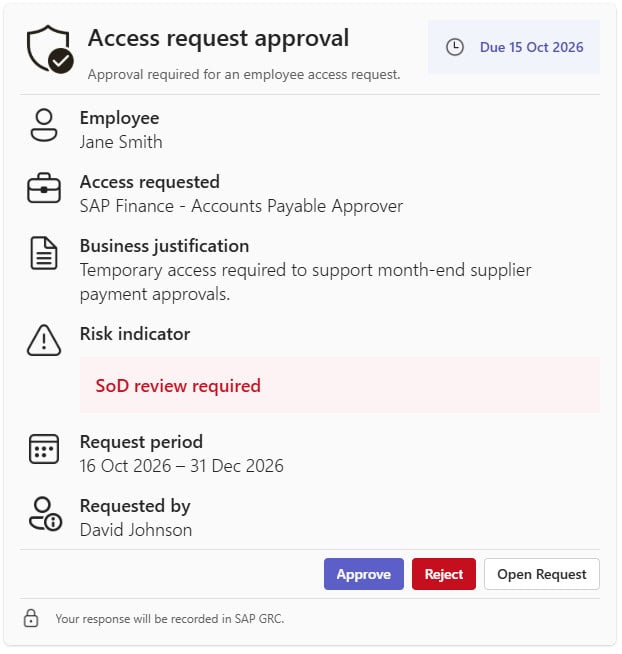
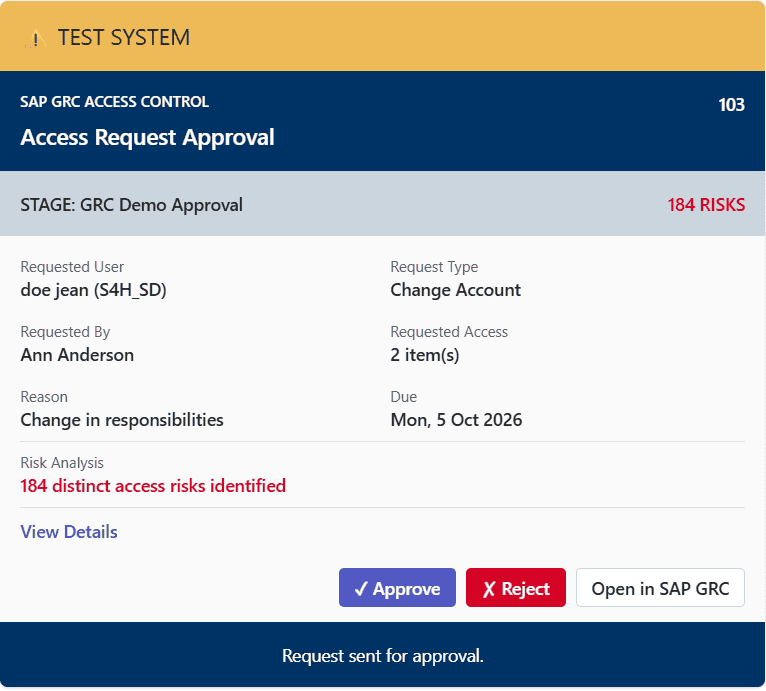
When an employee requests access, a manager may need to confirm whether that access is appropriate for the person’s job. When a role introduces a segregation-of-duties issue, an additional owner or approver may need to review the request. When a mitigation is assigned, a control owner may need to confirm that the control remains valid. During an access review campaign, managers or role owners may need to certify whether users still require access.
Even a well governed and well-designed process is slowed down if the participant does not respond. In many cases, the bottleneck is not the access-risk analysis itself. It is waiting for the right person to complete a specific step.
That distinction is important. We don’t necessarily need to change the underlying governance process to add value. Adding value comes when we make the business-facing steps more visible, more accessible and easier to complete promptly.
The occasional approver is often the weak point
GRC specialists usually understand where to find their work, how to interpret access-risk information and how to progress an item through the system. Occasional approvers have a different experience.
A manager may understand the employee’s role perfectly well, a process owner may be able to confirm whether access is needed, a control owner may know whether a control is still operating, but But each may not be in the the habit of checking a GRC inbox, may not see the task quickly and may respond late if the request is outside their normal flow of work.
This is not resistance to governance. It is a practical issue of attention and working patterns.
Most business users spend their day trawling through emails, engaged in meetings and focused on line-of-business applications and Microsoft Teams. If a GRC-related task is not visible in that working environment, it can sit waiting even when the decision itself is straightforward.
Delays matter in access governance
It is tempting to see access approvals and remediation tasks as administrative steps. In practice, they affect both operational efficiency and control discipline.
What is the cost of a delayed access request response? Employees unable to complete work, support teams overwhelmed by queries, and managers creating workarounds to keep business activity moving. When review or remediation tasks are delayed, the governance team spends their time following up, instead of actioning the required task.
We don’t want to bypass SAP GRC, simplify the risk analysis or ask managers to become access specialists. Rather, what we do want is to make sure the right person sees their task, and is able to complete it easily.