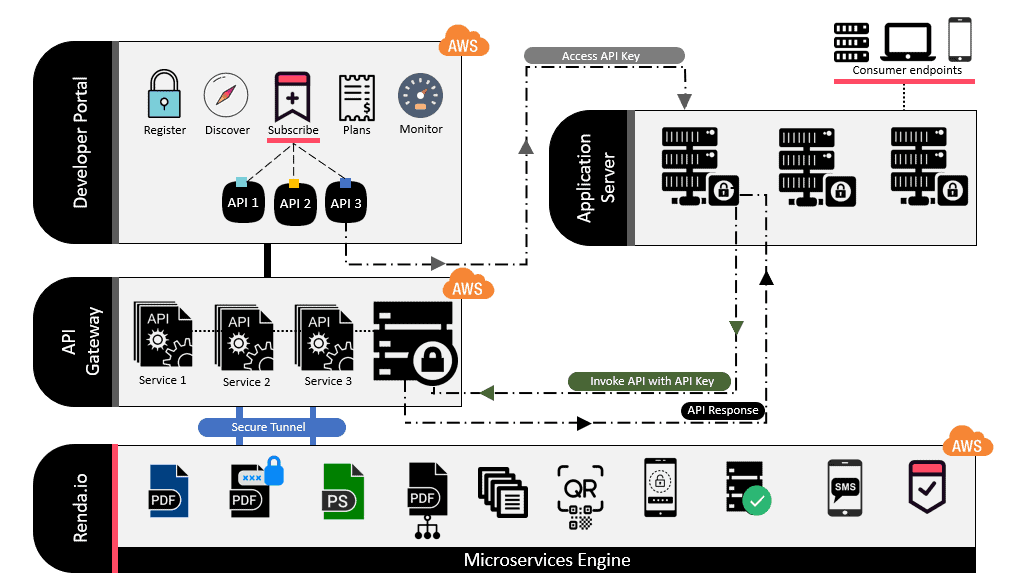



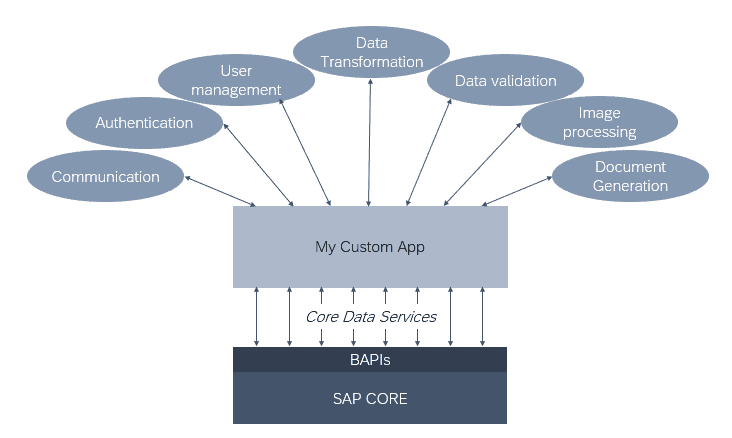
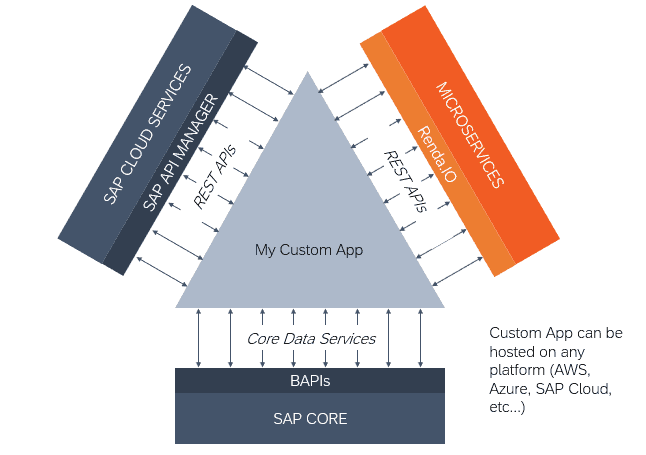
The microservices enable a different approach to app development, which is less reliant on SAP back-end data processing, and protects the core SAP systems from processes that do not require database read or write requests.
With this approach, developers have the freedom to host their app on different platforms, like AWS and Azure, and utilise the best services, whether they are hosted on the SAP Cloud or outside the SAP universe.
Use Cases
Fiori Printing
There are many scenarios in which users want to capture the data from a Fiori app into a printed output or as a saved PDF document, in order to generate a physical or electronic document. This might be where a process requires a wet signature, or a separate audit needs to be captured. With Fiori Print Integration you can enhance your Fiori apps to include a button to generate PDF. The Renda.io microservice will take the content in the currently displayed page and use this to generate the PDF document, returning this to the user in the browser. The user can then decide to save or print the document.
The Renda.io service can convert any HTML to a PDF document, with optional encryption.
SAP Output
Many SAP output documents (such as order confirmations, purchase orders and customer statements) can now be easily built, managed and sent by email to business partners using Arch Floe. In some scenarios an electronic version of the output (PDF document) is required for audit or archive. In other scenarios a physical print may still be required. With PDF Integration you can generate the PDF document output, using Floe for the design of the document and Renda.io for the document generation. This means that you can upgrade from the SAP legacy technologies such as SAPScript and SMARTFORMS, and put the task of document build in business users’ hands instead of IT. Optionally, you can use Renda.io to add a password to the PDF document to make it secure. Floe 210 automatically integrates with Renda.io, and for non-Floe output generation, sample code for both back -end (ABAP) and front-end (SAPUI5) scenarios is included.
Barcode / QR Code Generation
For processes that create documentation to be printed, shared in presentations or sent by email it can be really useful to use QR codes to direct users to web resources instead showing the URL path. In some cases the QR could be user-specific, directing them to a particular page with, for example, an encrypted customer number in the link. With QR Integration you can dynamically generate the QR code image programmatically, so that it can be added into the document you are creating. The renda.io microservice takes a URL and returns the image. Sample code for both back -end (ABAP) and front-end (SAPUI5) scenarios is included.
One-time Passcode Generation & Validation
In scenarios where users are not already authenticated, such as in websites and chatbots, it can be necessary to authenticate the user before sending or showing data using one-time passcodes (OTP). With TOPT Integration you can add OTP generation and validation functionality to chatbots using SAP Conversational AI. The first renda.io microservice will generate the OTP, so it can be sent to the user by email or SMS. The second microservice will validate the OTP that the user enters into the chatbot or website.
SMS Message Communication
In scenarios where an app needs to trigger an SMS text message to the user, for example, in sending a one-time passcode to a mobile device, then the Renda.io SMS service can be used to send the text message: There is no need to trigger a call to the SAP back-end for this purpose.
Floe 220 supports the design of text messages dynamically, with variable substitution and pre-delivered integration to the Renda.io SMS service for delivery.
Technology
Renda.io runs on highly scalable and available secure servers from AWS using Lambda serverless computing. The services are called using REST APIs, so is straightforward to set up and exploit, even in non-SAP scenarios.