




SAP GRC Finds the Risk. The Business Still Has to Act.
SAP GRC Finds the Risk. The Business Still Has to Act.
How Looply can help keep access governance workflows moving
SAP GRC processes are designed to support controlled access governance. They help organisations identify access risks, route approvals, assess segregation-of-duties conflicts, manage remediation steps and maintain an audit trail around access-related decisions.
But even a well-designed GRC process depends on people.
Some of those people work in security, compliance or access governance every day. Others do not. A line manager may only see an access approval occasionally. A role owner may only be asked for input when a particular role creates a conflict. A control owner may only need to respond when a mitigation or review is due.
That is where delays can appear. Not because the process is badly designed, but because the required step depends on someone outside the core GRC team noticing the task, understanding what is being asked and responding in time.
Looply helps with that participation gap. By bringing selected SAP GRC-related actions into Microsoft Teams, Looply makes it easier for managers, owners and approvers to complete their part of the process from the place where they already work.
SAP GRC workflows depend on business participation
Access governance is not only a technical process. It often requires business input at key points.
When an employee requests access, a manager may need to confirm whether that access is appropriate for the person’s job. When a role introduces a segregation-of-duties issue, an additional owner or approver may need to review the request. When a mitigation is assigned, a control owner may need to confirm that the control remains valid. During an access review campaign, managers or role owners may need to certify whether users still require access.
Each of these steps can be well governed, but the process still slows down if the participant does not respond. In many cases, the bottleneck is not the access-risk analysis itself. It is waiting for the right person to complete a specific step.
That distinction is important. Looply does not need to change the underlying governance process to add value. Its role is to make the business-facing steps more visible, more accessible and easier to complete promptly.
The occasional approver is often the weak point
GRC specialists usually understand where to find their work, how to interpret access-risk information and how to progress an item through the system. Occasional approvers have a different experience.
A manager may understand the employee’s role perfectly well, but may not be in the habit of checking a GRC inbox. A process owner may be able to confirm whether access is needed, but may not see the task quickly. A control owner may know whether a control is still operating, but may respond late if the request is outside their normal flow of work.
This is not resistance to governance. It is a practical issue of attention and working patterns.
Most business users spend their day in email, meetings, line-of-business applications and Microsoft Teams. If a GRC-related task is not visible in that working environment, it can sit waiting even when the decision itself is straightforward.
For access governance, that delay matters. A pending approval can prevent an employee from getting the access they need. An unresolved remediation step can keep an item open longer than necessary. A delayed certification response can make an access review campaign harder to close. The result is more chasing, more status checking and more effort for the GRC team.
Delays matter in access governance
It is tempting to see access approvals and remediation tasks as administrative steps. In practice, they affect both operational efficiency and control discipline.
When access requests are delayed, employees may be unable to complete work, support teams may receive avoidable queries, and managers may create workarounds to keep business activity moving. When review or remediation tasks are delayed, open items remain unresolved and the governance team has to spend more time following up.
Speed does not mean weakening control. It means helping the controlled process complete sooner.
That is the key point for Looply. The value is not in bypassing SAP GRC, simplifying the risk analysis or asking managers to become access specialists. The value is in making sure the right person sees the required task and can complete it without unnecessary friction.

Bringing GRC actions into Microsoft Teams
Microsoft Teams has become the place where many business users already coordinate work. For managers and process owners, it is often a more natural place to receive a time-sensitive action than a specialist application they only use occasionally.
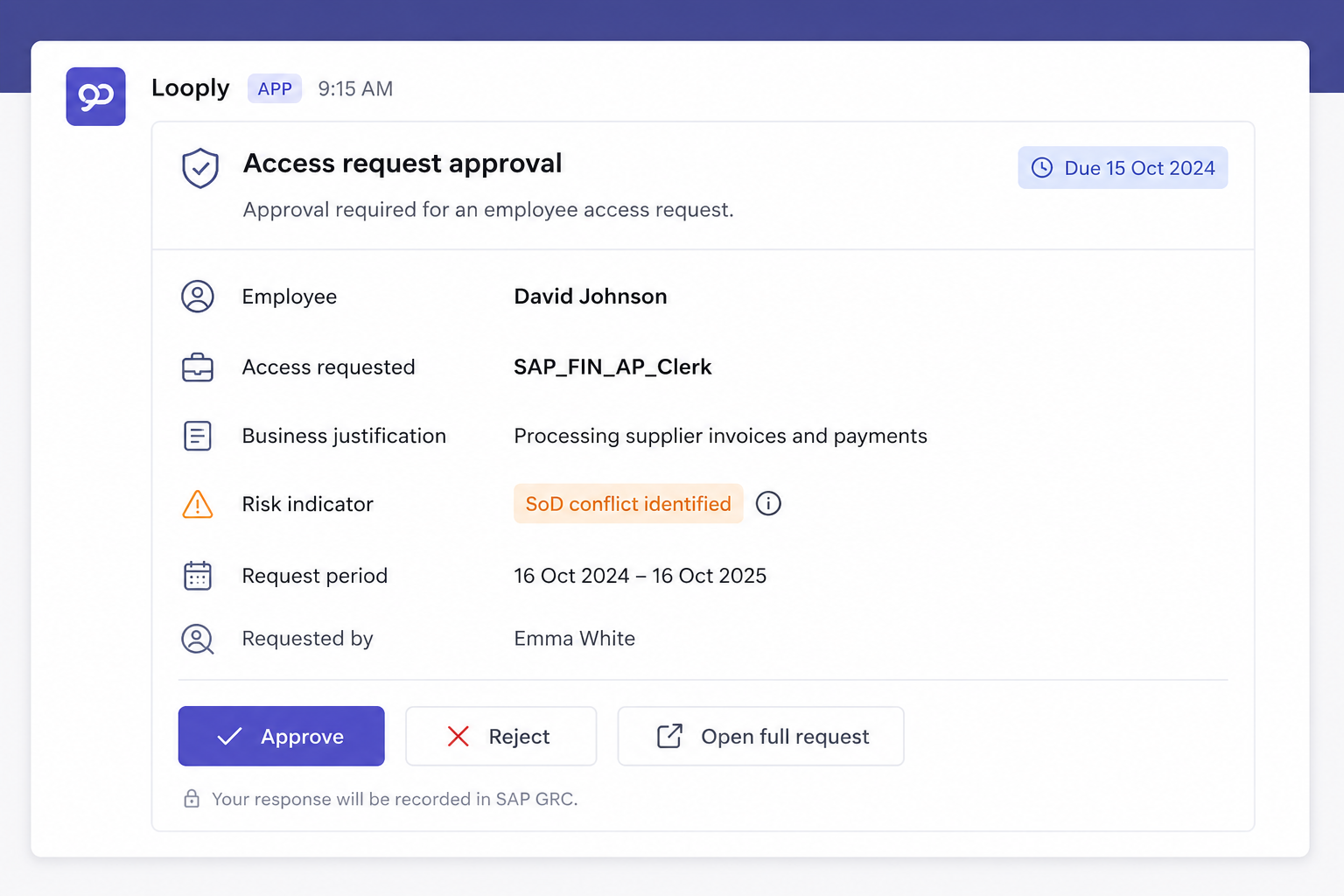
Looply can surface selected SAP GRC-related actions in Teams as focused, actionable notifications. A manager approving an employee’s access request can receive the request in Teams with the relevant business context. A role owner can be alerted when their input is needed on a role-related approval. A control owner can be asked to confirm a mitigation or review task. An overdue item can be escalated to the appropriate owner or backup approver.
The purpose is not to reproduce the full GRC application inside Teams. The purpose is to bring the required business step into a channel where the user is already active.
That makes the process more responsive. The user does not need to search for a task, remember to check another inbox or wait until they are back at a desktop session. They can see that action is required, understand the request, and respond from Teams on desktop or mobile.
For the GRC team, this can reduce the amount of manual chasing needed to keep work moving. For the business user, it makes participation easier. For the process as a whole, it helps reduce the number of items that remain open simply because they were not seen or prioritised.
Faster completion, fewer lost actions
The practical benefit is simple: fewer tasks waiting unnoticed, fewer reminders from the GRC team and faster movement from request to outcome.
This matters most where the workflow depends on occasional participants. A security analyst may process GRC tasks every day. A line manager may only see one once a month. That manager is much more likely to respond quickly if the task appears in the same collaboration environment they already use throughout the day.
Looply also helps avoid the problem of stale actions. When a task has been completed, the notification can be updated so that users are not left with old approval requests or outdated messages. That is especially important in access governance, where users should not be encouraged to act on information that is no longer current.
The result is a cleaner process experience. The task is visible, the response is captured, and the user can move on.
A better experience for managers and business owners
Access governance depends on cooperation from the business. If the process is hard for managers and owners to engage with, the GRC team has to compensate with reminders, explanations and manual follow-up.
Looply improves that experience by meeting users where they already work. A manager does not need to become a regular GRC user to approve an access request. A control owner does not need to hunt for a review item. A process owner does not need to wait for a separate reminder before responding to an escalation.
This is not just a convenience point. A smoother user experience helps the formal process work as intended. When people can complete their part quickly and clearly, the whole governance cycle becomes easier to manage.
Where Looply can support SAP GRC processes
Looply is particularly relevant where SAP GRC workflows need timely input from users outside the core access governance team.
For access request approvals, Looply can notify a manager that an employee is waiting for access and present the approval task in Teams. This is especially useful when the manager’s role is to confirm business need rather than perform detailed technical risk analysis.
For SoD-related access requests, Looply can help surface the additional approval or review step required from a business owner, role owner or control owner. The task can be presented as part of the workflow rather than becoming another item that has to be manually chased.
For remediation follow-up, Looply can route confirmation tasks to the relevant owner, helping the GRC team keep open items moving toward closure.
For mitigating control confirmations, Looply can bring recurring or event-driven confirmations into Teams, making it easier for control owners to respond when their input is required.
For access review campaigns, Looply can help remind reviewers of assigned work and support faster completion by placing review tasks in a familiar collaboration channel.
Across these examples, the same principle applies: when the process depends on business participation, Looply helps make that participation easier.
The action layer around SAP GRC
SAP GRC provides the governance process. Looply improves engagement with the people who need to participate in that process.
That makes Looply an action layer around selected SAP GRC workflows. It helps route tasks into Microsoft Teams, present the relevant context, capture the response and keep the process moving.
This is a practical improvement rather than a theoretical one. The benefit is measured in approvals completed sooner, fewer stalled requests, fewer reminders, fewer forgotten tasks and better visibility of where action is still required.
For organisations already using Microsoft Teams as a central part of daily work, this is a natural extension of the access governance process.
Make the business step easier to complete
SAP GRC can identify and govern access risk, but access governance still depends on timely input from the business. If managers, role owners and control owners do not see or complete their tasks quickly, the process slows down.
Looply helps by bringing selected GRC-related actions into Microsoft Teams, where business users already work. That makes those tasks easier to see, easier to complete and easier to track.
SAP GRC finds the risk. Looply helps the business act on it.