




Orchestrating APIs vs Executing Processes: Why Embedded Process Platforms Matter
Orchestrating APIs vs Executing Processes: Why Embedded Process Platforms Matter
Over the last few years, modern process orchestration platforms have become an increasingly popular part of enterprise architecture. Tools such as ServiceNow and SAP Build Process Automation promise faster delivery through low-code or no-code modelling, visual designers, and an expanding ecosystem of connectors. On the surface, they appear to offer a straightforward way to automate business processes without deep technical effort.
For many organisations, particularly those under pressure to deliver transformation quickly, this promise is compelling. However, once these tools are used beyond simple demonstrations and into real, production-grade business processes, a fundamental question starts to emerge: are these platforms actually executing processes, or are they merely orchestrating APIs?
This article argues that the distinction matters far more than it first appears. It also explains why platforms that execute processes — rather than simply coordinate integrations — are fundamentally better suited to owning SAP-centric business outcomes.
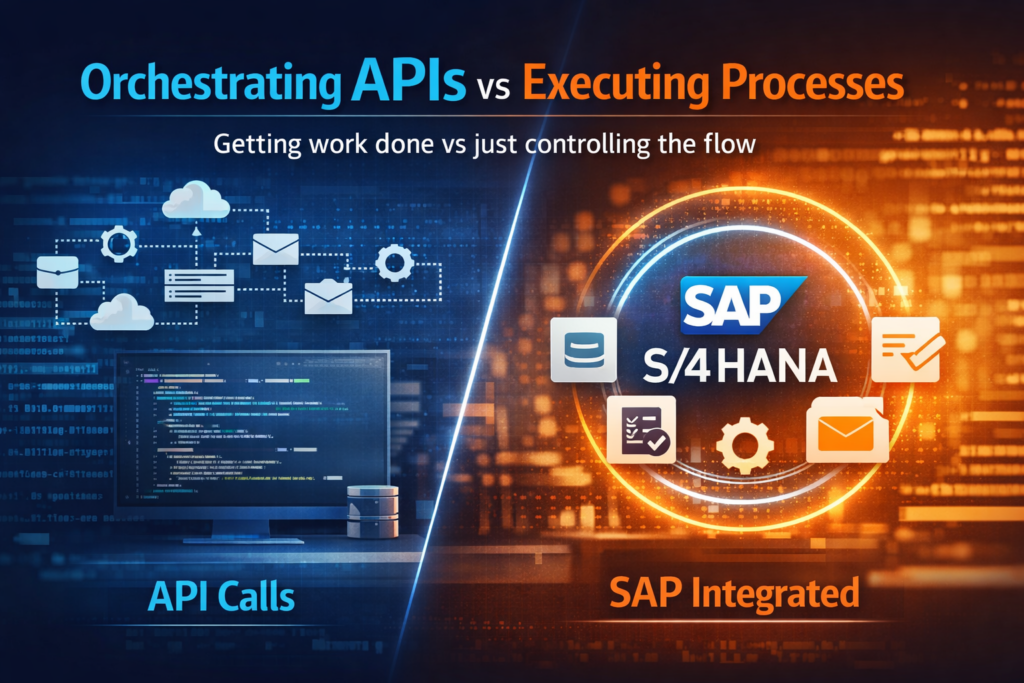
Where orchestration stops and real work begins
At their core, general orchestration engines are coordination tools. They excel at sequencing steps, routing tasks, and reacting to events. What they do not do particularly well is execute meaningful business logic on their own. As soon as a process needs to do anything substantive — such as pre-filling data, validating user input, resolving business rules, determining approvers, persisting data, updating a system of record, or generating outputs — the orchestration layer must call an API.

As a result, the “process” very quickly becomes a chain of external calls. Data capture may happen in one place, validation in another, business rules somewhere else, and persistence in yet another system. The orchestration engine is no longer the process; it is simply coordinating other components that actually do the work.
This approach is not inherently wrong, but it has important consequences. When execution is distributed across APIs, the orchestration layer cannot truly own data integrity, transactional behaviour, or accountability for outcomes. Complexity increases, and long-term maintainability becomes a concern.
When no-code becomes configuration-heavy engineering
Low-code and no-code platforms are often positioned as a way to remove technical barriers. In practice, they tend to replace traditional coding with dense layers of configuration. Complexity does not disappear; it is redistributed into mappings, expressions, conditional routing, connector settings, and opaque platform-specific behaviours.
As processes grow, development often becomes an exercise in trial and error. Without a proper debugger or execution context, designers are forced to repeatedly run workflows, inspect partial payloads, and infer behaviour from logs that describe technical steps rather than business intent. Small changes can require disproportionately large amounts of testing, simply to confirm that a configuration tweak has not broken an API interaction somewhere downstream.
Research into low-code adoption reflects this reality. While these platforms can accelerate early delivery and improve collaboration between IT and the business, studies consistently highlight challenges around customisation, interoperability, and testing once processes move into enterprise-grade scenarios. Empirical analysis of real developer discussions shows that integration issues, platform limitations, and lack of effective debugging support dominate day-to-day experience — a clear signal that theoretical simplicity does not always translate into practical execution.
What is often overlooked is the impact this has over time. Processes may be easy to start, but they become increasingly hard to change. Ownership concentrates around a small group of specialists, and the promise of agility quietly erodes.
The hidden security and identity tax
API-centric processes also introduce a significant and often underestimated security burden. Every integration point requires authentication, authorisation, token management, and lifecycle governance. Service accounts must be created, privileges assigned, scopes defined, and credentials rotated. Identity models must be mapped or duplicated across platforms that were never designed to share a common security fabric.
Over time, this leads to a proliferation of technical users and trust relationships that are poorly understood outside specialist teams. Even minor process changes can trigger security reviews, slowing delivery and increasing risk. In regulated environments, this overhead alone can become a blocking issue.
Crucially, all of this effort exists despite the fact that the system of record already understands users, roles, organisational structures, and approval hierarchies. When process execution is moved away from that system, security has to be rebuilt — and continuously maintained — elsewhere.
Debugging distributed processes and payload archaeology
When something goes wrong in an API-orchestrated process, troubleshooting is rarely straightforward. Engineers and support teams find themselves reconstructing execution paths across multiple tools, correlating timestamps, and inspecting JSON payloads at different stages of the flow. The question quickly shifts from “what business rule failed?” to “what data was passed at step seven, and how did it differ from step three?”
This form of debugging is fundamentally technical in nature, even when the underlying issue is a business one. Visibility is fragmented, and context is lost as data moves between systems. For the business, this often manifests as processes that appear to have “run successfully” but produced the wrong outcome, with no clear explanation why.
The problem is amplified by API sprawl. As organisations adopt more platforms and integrations, the number of APIs — and their interdependencies — grows rapidly. Industry research consistently identifies API sprawl as a major operational and security challenge, increasing governance overhead and expanding the attack surface. In orchestration-heavy solutions, this sprawl is not incidental; it is built into the way processes are executed.
The cumulative cost of API dependency
While these challenges may be manageable in the short term, their real impact is felt over time. Each API dependency becomes a potential failure point. Backend changes, platform upgrades, connector deprecations, or security updates can ripple across dozens of processes. Latency increases as network round-trips accumulate, and resilience logic must be layered on top to handle partial failures and retries.
The long-term cost is not just technical but organisational. Processes become fragile, difficult to evolve, and increasingly dependent on a small number of individuals who understand the full web of integrations. What initially looked like agility quietly turns into technical debt.
A different approach: processes that actually execute
An alternative approach is to rethink where process execution should happen. Instead of treating the orchestration layer as the centre of gravity, execution can be embedded where the data, rules, and transactions already live.

This is the philosophy behind Arch’s platform. Rather than relying on external APIs to perform every meaningful action, the platform provides native capabilities for data capture, validation, rule evaluation, persistence, approvals, escalations, document generation, and communication. The process engine does not merely coordinate work; it executes it.
This reduces the number of moving parts, eliminates entire classes of integration risk, and gives the process clear ownership of outcomes.
Embedded execution inside SAP S/4HANA
When processes are executed inside SAP S/4HANA, business logic runs alongside business data. Validation happens at the point of entry. Rules are evaluated against live transactional and master data. Authorisations and organisational structures are reused rather than recreated. Updates are performed transactionally, with clear success or failure states.
This dramatically reduces reliance on external APIs. Where integrations are required, they are deliberate and focused, not pervasive. The process behaves as a coherent unit of execution rather than a distributed choreography of calls.
Just as importantly, this approach aligns naturally with SAP’s security, audit, and lifecycle model. Processes inherit SAP-grade authorisation, traceability, and upgrade compatibility, rather than approximating them elsewhere.
Orchestrating outcomes, not APIs
The contrast between these approaches can be summarised simply. General orchestration tools are excellent at connecting systems. Embedded process platforms are designed to deliver outcomes.
Problems arise when tools built for coordination are asked to take responsibility for execution — particularly when those processes own data, business rules, and decisions. This is not a criticism of orchestration engines themselves. They play an important role in event-driven architectures and cross-system integration. The issue is misuse, not existence.
The table below highlights the practical differences.
Embedded Process Execution vs API-Orchestrated Processes

Extending processes outward without fragmenting them
Embedded execution does not mean isolation. Modern processes still require collaboration and engagement beyond the SAP user base. Arch’s platform allows processes to be extended outward — for example, through approvals and notifications in Microsoft Teams — while keeping ownership and control firmly within the core process.
These touchpoints are driven by the same rules, context, and security model as the underlying SAP process. Users interact with meaningful business information rather than generic tasks, and decisions flow directly back into the system of record.
Choosing the right tool for the right layer
A pragmatic architecture recognises that not all processes are the same. Some flows are genuinely about choreography across systems. Others represent core business logic that should live close to the data it governs. Treating both with the same tooling introduces unnecessary complexity.
Arch’s platform is not trying to replace integration platforms or event brokers. It is designed for processes that own data, rules, and outcomes — and that responsibility is best handled where those elements already exist.
Reduce friction instead of adding layers
The goal of process automation should not be to introduce more platforms, more connectors, or more abstractions. It should be to reduce friction, improve control, and make processes easier to understand, change, and govern over time.
By embedding execution rather than orchestrating APIs, organisations can move away from fragile, configuration-heavy workflows and towards processes that behave like first-class business assets. For SAP customers looking to model and run real business processes — not just coordinate integrations — Arch’s platform provides a more executable, secure, and maintainable foundation.