




Rethinking SAP Output: From Document Generation to Business Communication
Rethinking SAP Output: From Document Generation to Business Communication
For decades, output in SAP systems has been treated primarily as a document generation problem. The goal was simple: produce a printable document, often a PDF, and deliver it by post or email.
Despite major technology shifts — from SAPscript and SMARTFORMS to Adobe Forms and, more recently, S/4HANA Output Management — that underlying mindset has largely remained unchanged. Output is still designed for print, and email is still treated as little more than a delivery mechanism for attachments.
The real issue is not that SAP output is outdated.
It is that very different output scenarios are still being treated as if they are the same problem.
In reality, SAP output spans multiple categories, each with distinct requirements. Treating them all with a single approach leads to unnecessary complexity, fragile designs, and poor user experience.
This article explores those categories and explains where Floe, Floe together with Varo, and Looply each fit — and where they deliberately do not.
Not All SAP Output Is the Same
Before comparing technologies, it is important to recognise that “SAP output” is not a single use case.
Broadly, SAP output falls into four distinct categories:
- Print-centric operational output
- External business communication
- External communication with regulated documents
- Internal notifications and approvals
SAP output strategies struggle when they attempt to solve all four with the same tools.
Category 1: Print-Centric Operational Output
When Printing Is the Business Requirement
Some SAP output scenarios are fundamentally about printing, not communication. Typical examples include:
- Warehouse and logistics labels
- Barcode and QR code labels
- Pick lists and packing documents
- High-volume, device-specific print output
These scenarios are characterised by:
- Tight coupling to printers and hardware
- Very specific layout and sizing requirements
- No expectation of email or user interaction
- Operational speed taking priority over presentation
This is still SAP output, but it is not a fit for Floe or Floe + Varo.
In these cases, traditional SAP output technologies — including SMARTFORMS, Adobe Forms, or specialist label-printing solutions — remain entirely appropriate. Attempting to force communication-centric tools into these scenarios adds risk without delivering value.
Key point:
Not all output should be modernised in the same way. Print-driven operational output should remain print-driven.
Traditional SAP Output (Documents First)
SAP’s native output technologies excel at generating documents, but they share a common assumption: the document itself is the output.
This model still dominates many S/4HANA systems — even when the recipient never prints the document.
Detailed Comparison: SAP Native Output Approaches
| Dimension | SAPscript / SMARTFORMS | SAP Interactive Forms by Adobe (SFP / ADS) | S/4HANA Output Management |
| Primary design goal | Printed output | Pixel-perfect PDF | Rule-driven PDF output |
| Core output artefact | Spool / print | ||
| Email role | Print delivery alternative | Transport for PDF attachment | Transport for PDF attachment |
| Business context in email body | Not supported | Not supported | Not supported |
| Default assumption | Print & post | PDF attachment | PDF attachment |
| Output determination | ABAP logic | ABAP logic | BRF+ decision tables |
| Transparency of logic | Medium | Medium | Low at scale |
| Handling of regional variants | Custom copies | Template duplication | BRF+ explosion |
| Testing impact of changes | High | Very high | Extreme in global scenarios |
| Business-user involvement | None | None | None |
| Typical failure mode | Rigid layouts | Testing bottlenecks | Rule sprawl and fragility |
This approach persists not because it is optimal, but because it is deeply embedded. Output logic is often tightly coupled to pricing, delivery, and billing processes, making change risky. As organisations scale globally, the cost of modifying output increases disproportionately — and teams become reluctant to touch it at all.
Category 2: External Business Communication (Email First)
Reframing Output as Communication
External communication with customers, suppliers, and partners has very different requirements:
- Information must be immediately visible
- Content must render well on any device
- Attachments should be optional, not mandatory
- Branding, clarity, and context matter
This is where Floe fundamentally changes the model.
Floe is still SAP output, but it redefines what output looks like.
Instead of treating email as a delivery mechanism, email becomes the output.
With Floe, the business context is presented directly in the email body using structured, responsive HTML — designed to be read, not downloaded.
Detailed Comparison: SAP Native Output vs Floe
| Dimension | SAP Native Output | Floe |
| Primary channel | Document | |
| What the recipient reads | Email body | |
| Business context location | Inside document | Inside email |
| Email design model | Technical, system-driven | Graphical, structured, responsive |
| Device optimisation | Limited | Designed for all devices |
| PDF usage | Mandatory | Avoided by design |
| Replace PDF attachments | Not a design goal | Explicit design principle |
| Impact on email size | Large | Reduced |
| Firewall / deliverability risk | Higher | Lower |
| Processing & storage impact | Higher | Reduced |
| Change ownership | IT-centric | Moves closer to the business |
| Typical use cases | Invoices, orders | Notifications, confirmations, summaries |
Replacing PDF attachments is not just a usability improvement. It reduces delivery failures, processing overhead, and storage impact, while improving comprehension — especially on mobile devices.
Category 3: External Communication with Regulated Documents
When PDFs Still Matter
There are legitimate scenarios where PDFs remain essential:
- Regulatory or compliance documents
- Customers who explicitly require printable formats
- Scenarios demanding pixel-perfect layouts
The answer is not to abandon PDFs, but to use them deliberately.
This is where Floe + Varo provides a combined strategy:
- Floe remains responsible for the communication
- Varo is used only where complex PDF rendering is required
Detailed Comparison: Floe vs Floe + Varo
| Dimension | Floe | Floe + Varo |
| Primary communication channel | ||
| Business context in email body | Yes | Yes |
| Simple PDF usage | Yes, using Renda.io | Supported |
| Complex PDF rendering | Not intended | Supported |
| Regulatory / compliance documents | Not intended | Supported |
| Output ownership close to business | Yes | No |
| Governance & control | Light | Stronger, IT-governed |
This distinction is intentional. Floe alone empowers the business to move quickly. Floe combined with Varo reintroduces tighter governance where the document itself carries legal or operational weight.
Category 4: Internal Notifications and Approvals
Why Internal Email Is the Wrong Channel
Many SAP systems still rely heavily on automated internal emails for:
- Workflow notifications
- Approval requests
- Status updates
These emails are easily missed, buried in inboxes, or duplicated across channels.
For internal communication, Arch recommends Looply instead of Floe.
- Internal notifications belong in Microsoft Teams, not email
- Approvals should happen where people already work
- SAP events should surface as actionable tasks, not messages
This creates a clear, intentional split:
Internal communication → Looply (Microsoft Teams)
External communication → Floe (Email)
Detailed Comparison: Internal Email vs Looply (Teams)
| Dimension | Internal Email | Looply (Teams) |
| Primary channel | Email inbox | Microsoft Teams |
| Visibility | Easy to miss | Highly visible |
| Actionability | Passive | Action-driven |
| Context switching | High | Low |
| Approval experience | Link-based | In-context |
| Notification fatigue | High | Reduced |
| Alignment with daily work | Weak | Strong |
| Auditability | Limited | Strong |
| Recommended usage | Legacy only | Preferred approach |
A Clear Output Strategy for SAP
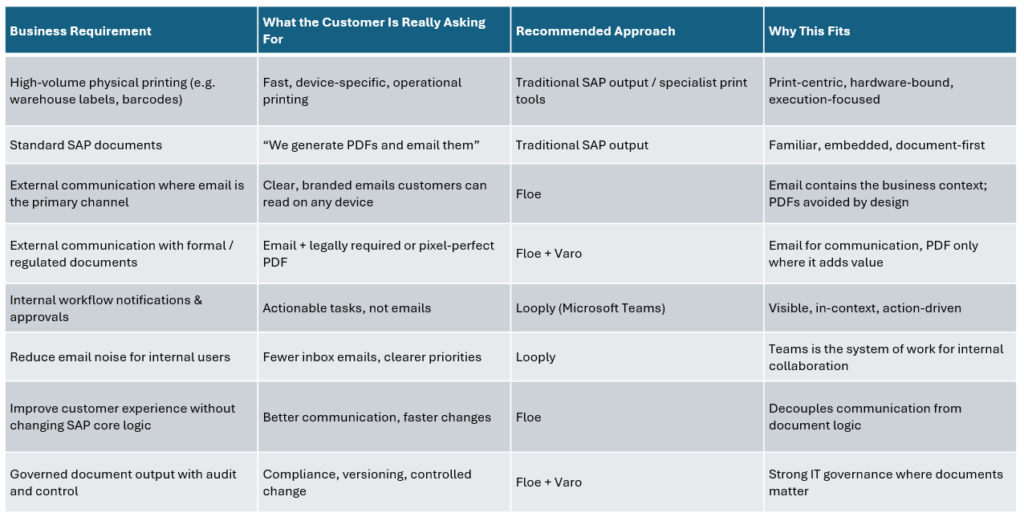
Bringing these categories together:
| Output Scenario | Recommended Approach | Rationale |
| Warehouse labels, barcodes | SAP native / specialist tools | Print-centric, device-bound |
| External communication (email-first) | Floe | Business context in email |
| External communication with complex PDFs | Floe + Varo | Controlled document rendering |
| Internal notifications & approvals | Looply (Teams) | Actionable, visible, in-context |
From Output Generation to Intentional Communication
SAP’s native tools are excellent at generating documents.
Arch’s approach recognises that not all output is the same — and that communication channels should be chosen deliberately.
By separating print-centric output, external communication, regulated documents and internal notifications, organisations can reduce complexity, improve user experience, and align SAP output with how people actually work today.